at The Red and The Black, 6/13/2006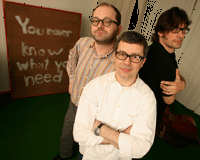 Swiss jazz trio featuring Christoph Gallio (soprano & alto saxophone), Christian Weber (double-bass), and Michael Griener (drums). I think they're in the States now because of an appearance at this year's Vision festival in New York City. Lucky for us, they came to DC as well...
They played a collection of compositions by Gallio. Somewhat difficult to describe - his style is very thorny and fragmented. Very few lyrical passages or what might come off as "lines." Mostly skittering bursts of notes, but still with a very clear contour and logic. Much of the music is notated - it was hard to tell what was notated and what was improvised, with the exception of a few bass solos. The sax "solos" were much in the same style as the notated material. In some ways, Anthony Braxton comes to mind as a reference point, but the actual musical vocabulary is quite different. Sort of like post-classical music, mixed with the jazz idiom, put through an atom smasher, and then carefully notated.
The ensemble was very strong - really tight playing. The show proved to be an interesting composition lesson, although after a while a certain same-ness among the pieces became apparent. That's not necessarily a criticism -- just seems like Gallio has found a very specific niche to work in, and is exploring this narrow area in great detail.
The venue is quite nice - hopefully it will last, and continue to host cutting-edge music.
Thursday, June 15, 2006
Day and Taxi

Thursday, May 25, 2006
Washington Musica Viva
at The Dennis & Phillip Ratner Museum, 5/23/2006
Another winning concert from WMV... Opened with Bach's Cantata No. 82 - sung beautifully by Gary Poster. It was done as a chamber piece - one player per part, which created a gorgeous kind of intimacy. Soprano saxophone was substituted for oboe, which really worked nicely. Rhonda Buckley played it beautifully. Her soprano sax playing has a warm, rich tone that blended nicely with the strings - a much more luxurious sound than an oboe. I hope they made a recording - I wish I could link to an mp3 so you can hear how that worked...
Next up, Faure's La Bonne Chanson. As I've written before, I'm not such a huge fan of classical vocal music, but this piece is an exception to my rule (and now I can add Cantata no. 82 to that list as well - seems like anything Gary Poster sings winds up on my growing list of exceptions). Mezzo soprano Karyn Friedman delivered a rock solid performance - teetering on the edge of losing control, just as the poems are. I think this is the first time I've heard this set of songs done by a female voice? Well, it works just fine that way. The ensemble was excellent (string quartet and piano).
After intermission (where all of Cameron's cookies were enthusiastically devoured), we heard Ernest Bloch's Piano Quintet #1. It was given an energetic and convincing performance, but I wasn't really won over by the piece. Lots of homophonic string writing, there were very few sections where the strings really got to function independently of one another. There were a small handful of "modern" elements and effects, but overall it sounds pretty conservative to me. I think that might be my hang-up with Bloch's work overall... it's not "modern" enough to be interesting for unique sounds and textures, and not conservative enough to stand up as "neo-classical" either. The quintet certainly has its moments, but I felt like it's a bit longer than it needs to be. That being said, the performance was super. Carl Banner (piano) was joined by Sally McLain (violin), June Huang (violin), Betty Hauck (viola), and Amy Leung (cello).
Wednesday, May 17, 2006
Aw shucks
I missed this show on Monday night because I had a gig at the same time. Hopefully Pretty Girls Make Graves will appear in DC again soon?
Friday, May 12, 2006
National Symphony Orchestra
at the Kennedy Center Concert Hall, 5/11/2006
Thanks to an online 75th anniversary promotion, Cameron and I enjoyed a special treat: tickets to hear the NSO for only $19.30. We got to sit in "prime orchestra" seats, normally $65 each - way out of reach. Thanks NSO! Greg Sandow is right... offer cheaper tickets, program some interesting music, and young people (like us) will be delighted to hear orchestra concerts.
Stravinsky + Bartok + $20 = sign me up.
There's a review in today's Washington Post. One comment about the ticket price promotion: just because we're "young" and not subscribers, please don't assume that we don't know anything about classical music. That wasn't an issue with the concert at all... but the tone of the review made me nervous.
So about the music: two words - hell yes. Stravinsky's "Symphonies of Wind Instruments" is a treat to hear live, I've only heard recordings. Contrary to Post critic Ginsberg, this piece never occurred to me as an "academic study" (although I did study it in grad. school) - I felt like it came off exactly as promised in the program notes: a series of "short litanies." The winds and brass instruments all sounded warm and gorgeous. Even the bassoons.
The Mendelssohn Octet in E-Flat, Op. 20 was performed by the entire string section and sounded great. Now I'm curious to hear Leonard Bernstein's string orchestra treatment of Beethoven's C-Sharp quartet, Op. 131 -- I know he recorded it, but I haven't actually heard it yet. I was always suspicious of performing chamber pieces with a zillion players doubling each part -- but this totally won me over. Any "infelicities of ensemble" noted by Mr. Ginsberg went totally unnoticed by me. I was quite mesmerized with their ability to maintain the clarity of the chamber piece, and deliver the added lushness of a full string orchestra. Delicious.
I had mixed feelings about the Chavez "Toccata for Percussion Instruments." Slatkin introduced the piece by calling it the second important percussion piece in the repertoire after Varese's "Ionisations." I'm not so sure about that, but who am I to argue with the Maestro. I'm spoiled, I guess. Hearing the So Percussion Ensemble playing music by John Luther Adams at last year's Otherminds festival made this piece so very tame in comparison. And maybe hearing the automated "Ballet Mechanique" at the National Gallery last weekend didn't help either?
The program ended with Bartok's "Suite from the Miraculous Mandarin" which just plain rocked. I think Bartok is to classical music as Caspar Brotzmann is to rock music. His work is rigorous, and quite satisfying intellectually, but as you're listening it doesn't hit you in the cerebellum, it punches you in the gut and leaves you totally breathless. This was an especially nice bit of programming by Slatkin and Co. - after hearing the sections of the orchestra on display, the Bartok made for an amazing showpiece - that's not just a showpiece. Also a nice choice to do this one instead of his Concerto for Orchestra, which I think is a little less "accessible" (although still plenty accessible) - and also would have been too long to tack onto the end of this particular program.
So, wow. That was a real treat. I hope us "young people" will have more chances to hear the NSO before Slatkin retires.
Thursday, May 11, 2006
Sarah Azzara
at the Black Cat, 5/4/2006
Sarah rocked the Black Cat - it was a low-key CD release party for their new album, "It Turns Us On." The new record is quite excellent. Hear some of it and buy it at sarahazzara.com.
The band is a trio now, since their lead guitarist left to go back to school to become a CPA. I'm all for accountants that rock, but I think I preferred the quartet lineup. Two guitars really helped keep the balance - this time the bass and drums seemed a little overpowering. But seriously, check out the record. It's a winner.
Tuesday, May 02, 2006
John Vanderslice
at Iota, 4/29/2006 I got behind and haven't posted about any shows for a while... I'm not going to take the time to go back and catch up... we'll just have to deal with the gap in coverage.
John Vanderslice and his fabulous band played to a packed house at Iota. Damn his band is good. He's a very engaging performer, clearly very comfortable on stage, and immediately likeable. He conducts the performance as though we're all longtime friends and actually pulls it off. Of course it helps that the music is solid - and beautifully performed. Did I mention that his band is awesome? They are.
They've been on the road for a while, and it shows (in a good way). Everything sounded tight, but there was still enough room for all of the players to mix up some details and keep things fresh. At one point, Vanderslice stopped the show to listen to a change the keyboard player made to a delay setting, that changed the rhythm of a small accompaniment figure - this was followed by a demonstration so we all knew what he was talking about, and the drummer reluctantly gave a quick lesson in hemiola (and the drummer added a little triplet lick at the end of the following song to put it in context).
Basically, every song sounded lovely. They played for a good long while, and still didn't have time for a few favorites (no "dear sara shu" or "bill gates must die" or "speedlab" for example) but they delivered many of my personal favorites (i.e. "me and my 424," "angela," "time travel is lonely" and many others).
I splurged and bought a vinyl copy of his latest album, Pixel Revolt. It's pressed on two 180 gram discs that run at 45rpm -- and the sound quality is really spectacular (to be expected from an artist who's known as much for being a studio dork as he is a songwriter and performer). So much better than hearing the album as mp3's. But if you want to hear some mp3's, he's got loads of them on his site, including a few tracks from Pixel Revolt. Start here, but it's worth browsing the site for some older stuff too. (and I mean "studio dork" in the most respectful and affectionate way)
Page France opened. Stupid Pitchfork retains the well-deserved "stupid" prefix with this review. (although they did get a high score) I'm not sure why the review is so caught up in their music being "Christian." Certainly most of the songs deal with themes such as faith and love, served up with generous helpings of biblical imagery - but does that mean someone like Leonard Cohen was writing Christian music?
Wednesday, March 15, 2006
Arts Advocacy Day
When I started this little blog excercise, I made a decision to keep it focused very narrowly - only thoughts and impressions of live performances that I've seen. I have intentionally avoided posting anything about arts management - which is a significant portion of how I earn a living.
I'm going to bend my rules a bit for this quickie: Today's Post has a nice article by Phillip Kennicot about the lecture at the Kennedy Center last Monday, presented by Americans for the Arts as part of their Arts Advocacy Day activities. He really put his finger on the "big questions" facing the arts in America - but I think failed to make one important distinction: Who is the audience for this arts advocacy message?
Americans for the Arts has been very effective lobbying congress regarding arts funding - and has found similar success at the state and local level around the country based on a strategy of using an "instrumental" approach: meaning they talk up the economic impact of investing in the arts, and the benefits of arts education -- as opposed to talking up the "intrinsic" value of the arts (like how the arts provides an opportunity for transformational personal experiences - you know, the powerful stuff... I'm sure everyone can name some artworks that have changed and/or shaped their lives: a book, a play, a poem, painting, an album that you couldn't live without, etc). This strategy is working in the legislative arena.
Over the last few years, the Wallace Foundation and others have dumped lots of money into a study dealing with arts advocacy - it's simply referred to as the "Rand Study" by those in the know... it was conducted and published by the Rand Corporation. This study claims that existing arts advocacy efforts are missing an important component: namely the intrinsic value of the arts. Here's where things get a little dicey. Americans for the Arts have proven that nuts and bolts tangible benefits make a compelling case for legislators - so they're sticking with that (and rightly so, I think). However, there's certainly a need to have a broader public conversation about the value of the arts -- especially these intrinsic values.
Some efforts are underway in this area... a national initiative called LiNC (Leveraging Investments in Creativity) has been formed to address the needs of individual artists - as indicated in a large national study that was originally under the same name. (That study used to be online here, but it's gone missing?) There's a local initiative as part of this project, being housed at the Community Foundation, called the "Creative Communities Initiative." I have mixed feelings about how that's progressing... but can't really talk about it because I'm on the steering committee and we are, I think, under some vague confidentiality agreement -- so I'm not really sure I'm supposed to mention that it exists? Well, they're having a public event in April so I think I can at least say that and not be breaking any rules...
Anyway, blah blah blah... just wanted to point out the Kennicot piece in the Post really...
Here in DC, since there's no voting representation in congress, we spend Arts Advocacy Day at the Wilson building lobbying the City Council. Strange that this local advocacy effort is missing some key players... did anyone spot any staff members of the Cultural Alliance? I don't think so... and I won't name other names here in public... but there are a few other notable local arts leaders who were absent.
Ok, no more arts management rants on this blog.
Beth Orton with Willy Mason
At 9:30 Club, 3/12/2006
(guest blogged by Cameron Mcphee) Jon told me I could guest blog about this show because I was the one who “dragged” him to it. Ok, that is not actually how he put it, but I figure it’s only fair that he go to a few chick concerts with me since I am often the only "chick" in the room at some of his shows.
Actually, I think Patrick Foster wrote a really right-on review of the show in the Washington Post
I won’t try to repeat that. Bottom line, she really was fantastic. Cough or not, she not only has such a powerful voice, but I think she has a really unique sound. As the article hints at as well, the most striking thing about this show was that all of her new songs (from her latest album Comfort of Strangers) sounded even better live than they do on the CD. Honestly, as a lover of her older stuff, I had my doubts when I first heard this album, but after Sunday night, I have decided that these songs are at least as good, deep, and powerful as her older hits. Interestingly, I was... not disappointed... but under-whelmed by her acoustic renditions of her older stuff including two of my three all-time favorite Beth Orton songs, "Sugar Boy" and "Feel to Believe." Maybe it was because it just sounds so different without all the electronic mixing or maybe her new stuff coupled with her terrific back-up band just sounded so darn good. For the record my favorite new songs from the show had to be her opener, "Rectify" and "Safe in Your Arms."
Singer-songwriter Willy Mason opened in a duo performance with violist and singer Nina Violet. While I feel like his set was neither here nor there, I did learn one thing... If you recall from one of Jon’s previous show blogs, I think every band benefits from the deft use of the accordion. Well, it turns out the same is true for a well-played viola. It's just such a great sound and I think Mason and Violet take advantage of this fact very dexterously. Other than that, I think Jon and I agree that Mason doesn't really get the crowd's attention as an opening act. His songs are subtle and quiet and in most instances redundant. And the fact that I was continually distracted by the annoying woman at the bar below me, speaks to his inability to engage the crowd. Apparently Nina Violet has just released her first solo CD which I actually look forward to hearing. She has a very beautiful voice and is a great string player (I think she also plays the cello).
All in all, this show definitely re-vitalized my love of Beth Orton's music and I am glad she is not stagnant in her style, that she is allowing her music to grow with her.
Thursday, March 02, 2006
Heart of Gold
at E Street Cinema, 3/1/2006 The film, "Heart of Gold," is a Neil Young concert, filmed by Jonathan Demme. Normally, I wouldn't post about a movie, but Demme has a way of making films of live performances that really capture the essence of the live performance experience, and use all the tricks and tools at his disposal to create a kind of hyper-real experience. Remember "Stop Making Sense" and "Swimming to Cambodia"? The guy's got a gift... and more obscure, remember the PBS performance art series, "Alive from off center"? That was too good to last - and he had a hand in that too...
Anyway, there are many good resources already online where you can learn more about this beautiful film. I first heard about it thanks to Greg Sandow's blog post. There's also an interview w/ Young and Demme on Studio 360:
[link to transcript]
[or stream the segment, requires RealPlayer]
[or download the Studio 360 podcast for 2/12/06 - this is the segment included as the podcast for that week. here's the feed address]
They were also on "Fresh Air." Someone's got a good publicist...
I love the new songs in "Prairie Wind" - and many of his old "hits" sounded fabulous as well. Kudos to Neil Young (and the audio mixing team) for achieving the impossible: not letting Emmylou Harris steal the show. She certainly added a great deal, but her presence wasn't overpowering. (I only mean that as a huge compliment re: Ms. Harris' abilities...)
The performance was staged in a bizarrely anachronistic way - I guess to make it seem timeless? Costumes were a bit over the top, but the performance was so fabulous, and the cinematic treatment of it so perfectly executed, I really have no complaints. It's an absorbing document of a mature artist at the top of his game. 4 stars. A must see. Better than Cats.
unrelated: a hilarious review of Scott Stapp's show at 9:30 club thanks to DCist.
Sunday, February 26, 2006
There is No More Firmament
At the Warehouse Theater, 2/24/2006
Produced by Theatre Du Jour
[Note: This post is written by special guest blogger, Cameron McPhee.]
Yay, I have always wanted to be a guest blogger!
To preface, I should say that both Jonathan and I agree that any serious attempt to perform this kind of experimental theater in Washington is an asset to the DC arts scene. Setting aside, for the moment, that this piece has often been referred to as theatrically “unstageable,” it is certainly not something that the traditional DC theater audience is used to seeing (or paying for), making it, in some ways regionally unstagable. So I thank B. Stanley for taking on this project and I hope that there is more to come.
That said, I think this production “missed the point” a bit when it comes to creating the sort of theater Artaud called for. Artaud’s theater was, in most simplistic terms, grotesque. It is a “pre-logical” theater, which exists “halfway between thought and gesture”. Artaud’s mission was to create theater that physically (possibly violently) engages the audience and changes their perceptions of reality. Artaud’s technique is grounded in movement, breath, gesture, in essence – in the body. And while Stanley clearly understands this and articulates it when discussing the evolution of this piece, it does not seem to have translated to the stage. His actors were entirely too self-conscious, concerned about being “actors” and worrying about how they look on stage. This sort of vanity is the opposite of the theater of Artaud, which is about baseness, vulgarity, and often the more disgusting bodily functions. It is not about looking pretty.
My first justification for this was that this is a very amateur cast (demanded, of course, by the fact that, unfortunately, no-one can make any money off such a project). Many of the performers are young, some still in school. However, I don’t think inexperience is necessarily the problem. The best members of the ensemble, the ones I felt were the least concerned with “looking good on stage,” were actually those cast members who have never been in a theatrical production. Both Jerry Herbilla and Aaron O. Martin seemed to give themselves fully to the ensemble.
Along similar lines, I felt that the cast could have spent much less time changing costumes and moving back and forth various props and more time trying to work symbolically. B. Stanley’s bio in the program states that he was a student of Jerzy Grotowski (another theater director and theorist who explored many of the same issues about theater and it’s role as a manipulator of consciousness). Where Artaud called it “Theater of cruelty,” Grotowski’s was a “poor theater” by which he meant a theater that eliminated all that was superfluous and extraneous (props, costumes, etc.) and in its place left a “stripped” and vulnerable actor. An actor who can abandon the ego-protection provided by such amenities and transform themselves and the audience. He, like Artaud, desired a theater that was simultaneously a ritual. And I think the sparseness and open-endedness of There is No More Firmament could lend itself to just such a ritual experience.
This is not to say that there were not glimpses of true Artaudian theater in this production. At one point, three actors, draped in some kind of gray fabric onto which has been sewn several disembodied limbs, slither across the stage like war-ravaged slugs. This, more than any other moment, elicited the sensation that our society is slowly adjusting to increasing levels of violence, which we have learned to ignore just like we ignore, say, poverty -- covered in blankets and freezing on the street.
Similarly, one member of the ensemble, towards the end (during a scene in which the cast all wear lab coats and listen to the “scientific explanation” of the catastrophe they are experiencing) used gesture and movement in an exaggerated fashion, much like what I had hoped this whole production would attempt. Too bad she just seemed so out of place doing so.
B. Stanley and the Theater Du Jour ensemble have taken a much-needed step towards destroying the very rigid boundaries of Washington DC theater. I hope (though doubt) that this production will inspire other experiments along similar lines.
Friday, February 24, 2006
Vijay Iyer Quartet
at the Kennedy Center "KC Jazz Club," 2/23/2006
Pianist / Composer / Genius Vijay Iyer came to town with his quartet, which included: Rudresh Mahanthappa (alto sax), Stephan Crump (bass), and Marcus Gilmore (drums).
Yow. It was quite a performance. Olympics O'schmipics... the real skillz were on display right here at home. This was a group of virtuoso players / improvisers. Iyer's music is pretty damn complicated: intricate layers of polyrhythms, thorny twisting melodic lines, and surprising harmonic changes -- but woven together with real purpose and meaning. This wasn't simply a show of cerebral-dexterity-pyrotechnics, this was some heady music that also had great depth.
I'd love to write something that explains the rhythmic complexity in simple terms, but honestly, I couldn't do the math... lots of odd meters and cool juxtapositions, but that was just the basis for further exploration, not an end in itself. These players have all been in the orbit of Steve Coleman, and his M-Base collective. I think the rhythmic vocabulary, especially, is heavily influenced by that work.
Most of the set was devoted to a suite of pieces called "Tragicomedy" (he explained the title as a reference to Cornel West's use of the term to describe our current situation in the world). It was powerful and effective stuff - very well played. I don't know how these guys could solo over all of these tricky rhythmic patterns. The through-composed form also caused some confusion in the audience - people who wanted to applaud after every solo were somewhat stymied by the unconventional forms. It wasn't always clear when one solo had ended, or even started for that matter... It wasn't always obvious what was composed and what was being improvised.
Anyway, there's been a lot written about Vijay, and particularly about this group, since their album, "Reimagining" was on so many top-ten lists of last year (JazzTimes, ArtForum, Village Voice, and many more) - so I don't have to duplicate anything... I guess all I have to say is: damn. That was something. I'm dizzy.
Chris Porter wrote a review in the Post. Also up on his blog.
Wednesday, February 22, 2006
Washington Musica Viva
at the Czech Embassy, 2/21/2006
(note: I'm on the board of directors of Washington Musica Viva, so once again, I can't really be impartial. ok?)
After a brief hiatus, WMV has returned to the Czech Embassy to present a series of concerts presenting a nice mix of music by Czech composers. This program included one composer I hadn't heard before: Petr Eben. He's referred to as, "one of the leading composers of the Czech Republic," so I guess that's good that his work was included... His "Six Minnelieder" was performed by Karyn Friedman (mezzo-soprano) with Carl Banner at the piano. This collection of six short songs are all settings of medieval texts, in Czech, English, German, Italian, and French. Since I'm not multi-lingual myself, I found that to be somewhat alienating. The songs were sung beautifully, but I've never been really drawn to "art song" per se, and this was no exception. Just my own personal bias... but that being said, WMV has performed lots of vocal music that I really loved - which is pretty impressive since I'm really hard to please in this area. I just couldn't really get into these songs.
Next up was the "Rhapsody-Concerto" by Bohuslav Martinu. The piece, originally for viola and orchestra, was performed in a transcription for viola and piano. I'm really curious to hear the orchestra version (and I'm in luck... it's not in the DC Library, or Montgomery County Library, but there's a recording at eMusic.com) WMV has performed quite a bit of Martinu's music in the past, and I've always found it to be totally captivating. This work, however, didn't have as much fast material. He's a composer who really knows how to write fast music... and his jazz-inflected style keeps me more engaged than most classical music. This piece is overall, more moderate in tempo, but there are a few rockin' parts - and even slowed down a bit, Martinu's music is still very engaging. Philippe Chao did a super job with the viola. Someday I'll write something for viola... when it's played well, it's totally worth the trouble of dealing with the damn C-clef.
The program closed with Dvorak's "Piano Quartet No.1," played by Carl along with Hasse Borup (violin), Amy Leung (cello), and Phillipe Chao (viola). So far, I've led a seriously blessed life - some evidence of that is the fact that I've been able to hear Hasse and Amy play several times over the last few years. While I was in grad. school at Hartt, they were there with their string quartet - the Coolidge Quartet - studying with the Emerson Quartet. Then they followed me to Maryland, where they were studying with the Guarneri Quartet. Unfortunately, the Coolidge Quartet is no longer, but these two are really fabulous musicians and when they're playing in the area you would be well served by dropping everything and going to hear them. This was a crisp and lively rendition of the Dvorak. Sometimes I have a hard time with his longwindedness, but this performance kept me on the edge of my seat from start to finish, and I'm not just saying that because I want to publish nice things about WMV...
Hasse has a project in the works to record a CD of violin and piano music by Schoenberg, as well as music by Schoenberg's American pupils. It's an interesting concept - and we're now "in conversation" about bringing him in to perform in next season's "New Music Salon" series presented by the American Composers Forum. Hopefully we can make the dates work out!
WMV's next concert is coming up on March 19th at the Atlas, click here for more info.
Sunday, February 19, 2006
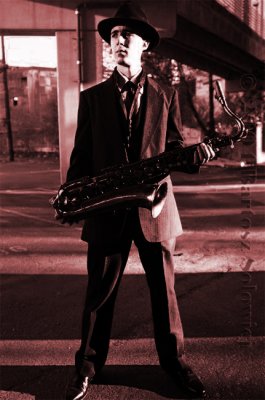
Will Scruggs, featuring Charles Phaneuf
 at Twins, 2/18/2006
Will Scruggs is a sax player from Atlanta. He was in town, playing with a group of local musicians, including my friend Charles. I met Charles because he's helping out with the upcoming Capital Fringe Festival. This was the first time I got to hear him play. Turns out Will is an old buddy of his.
Scruggs has a really nice sound - on tenor, alto, and soprano. No easy feat. His tenor sound has the smoky, full bodied goodness of someone like Joe Henderson. His alto playing had the lightness and agility of someone more like Michael Brecker. I'm not suggesting his playing is quite what those guys do... but he's got a wide ranging set of skills (and he can sing pretty well too).
Unfortunately, this was an ad-hoc group playing mostly standards - pretty straight ahead. My personal preference is for something a little more out-there, but they were good. Most of the solos of the evening were really clear and logically structured. I appreciate that kind of composing, but I also want something a little more visceral. The pianist especially - he has a fondness for circular little sequential patterns, and uses them quite creatively, but it struck me as kind of cold (although technically very solid).
Scruggs, on the other hand, pulled off a few Jimmy Smith like tricks - sitting on a single trill or ornament for a really really long time and making it sound powerful. That wasn't something he did often, which helped make it work.
I was impressed - and I think he's a promising talent. I hope he has the chance to stretch out some more, and play some more original music. The one original that was included in the set I heard was good (but still very straight-forward). Certainly someone to keep an eye on.
Great Noise Ensemble
at the Charles Sumner School, 2/17/2006
A new, local, chamber group dedicated to contemporary repertoire? Am I dreaming? No. It turns out this town has enough classically trained performers who have a collective screw loose to form a unique little chamber orchestra of sorts.
The program featured some nice tasty morsels: Steve Reich's "Clapping Music," Adam Silverman's "In Another Man's Skin," a chamber concerto in progress by Blair Goins, "Tango Variations" by one of the founding members of the group (and conductor), Armando Bayolo, and a goofy setting of "The Walrus and the Carpenter" by Tom Schnauber.
Full disclosure: I'm working with the group to figure out how they might function as an "ensemble in residence" for the ACF Chapter, so I'm a little biased.
The room at the Sumner School is fairly dry sounding, which made it difficult to achieve a nice ensemble sound, I'm not sure if that was made worse by the fact that this is only their second (I think?) performance. But overall, this was a promising evening and I'm looking forward to their upcoming concerts: next one in DC is May 12 at the Sitar Center - presented by ACF.
Friday, February 10, 2006
Mary Timony, The Aquarium, Picture is Dead
at Black Cat, 2/9/2006
The Picture is Dead sucked. I want to do this briefly, so as not to waste bandwidth or time - they don't deserve either. They violated both cardinal rules of being an opening band:
1. Don't Suck (more about that in a moment)
2. Don't play too long (they plodded through an interminable 8 songs)
Wow did they suck. We knew we were in trouble when they took the stage in "costume" of white lab coats... two synth players, one violin/guitar player, and vocalist. Plus one other lab-coated "video artist" who played DVD tracks of slideshows related to each song in terribly obvious ways. Imagine if you will, Devo - with no sense of humor and no drums. Or maybe one of those old Brian Eno albums with all the interesting qualities removed, so all you're left with is electronic "experimentation" and bad vocals. Watching their set was like watching a train wreck. They were so blissfully unaware of their suckitude it was like watching American Idol or something...
The Aquarium was ok. Their performances are kind of charming, with Jason Hutto flopping around like a muppet and Laura Harris rocking out on the drums. Unfortunately, Jason really can't sing. Seems like they are a successful local band more because of hipster credentials than quality rockin', but they're still kinda fun. And the projected old-timey science class films were amusing as well.
Maybe it was because it was so late by the time Mary Timony took the stage, or maybe I was just tired after going out to shows too many nights this week, but I didn't stay for her whole set. Her vocals were pretty sloppy - she actually can sing, but was choosing not to sing very carefully, it seems... Devin Ocampo is a great drummer and he delivered the perfect mix of ferocity and accuracy (two of my favorite qualities in a drummer). I guess it was my own fatigue, but I felt like I'd rather have been listening to Ex Hex at home then hearing it sloppified in an overcrowded club. That being said, Mary Timony still rocked and was pretty good.
Feist and Jason Collett
at Black Cat, 2/8/2006
Hooray! There's a decent review of the show at DCist, so that saves me some time...
They missed Jason Collett's set, so I'll add a bit about that:
He's a good singer (kind of a mix of Dylan, back when he could sing, and M.Ward with a few less marbles in the mouth). His band was quite good, and I suspect his new record is pretty solid although I haven't heard it yet. The style seemed to me like alt-country / indie rock, but more on the alt-country side. He'd make a perfect opening act for Lucinda Williams. During the last song, he un-ironically invoked The Boss, quoting the refrain of "Prove it All Night" in the midst of his own song. Curious. At several points, he took advantage of the Broken Social Scene "guitar orchestra" effect (five people on stage playing guitars, playing pretty much the same thing) - which created a nice wall-of-sound sorta thing. The poor man's alt-country Glenn Branca perhaps.
Note to extremely tall latecomers who weren't even interested in the show: please don't stand in front of me, or Cameron. It should be self-evident, but she's kinda small and can't see past you! And niether can I.
Cutest Puppy in the World, Insect Factory, Big Cats
at Black Cat, 2/5/2006
Big Cats played a very short set, hard to say much about it, other than I don't think I "got" it... maybe with a little more time I would've caught on, or things might have jelled a bit? Sean Peoples is such a driving force in the local indie/experimental/post-punk scene that I'm reluctant to post negative things about his work, since I wholeheartedly endorse what he's doing. So let's give 'em the benefit of the doubt and just leave it at "I was confused by their set."
Insect Factory was a pleasant surprise... they performed as a guitar/drum duo. Nice guitar textures and some good interaction between them. At times I wished the drummer either played much less, or much more intensely, instead of somewhere in the middle - but their set was promising (also really short).
Cutest Puppy seemed to have some troubles. Lots of feedback, and it looked like Layne was having a hard time with his microphone? Overall, not their best work - I think.
Sunday, February 05, 2006
Ethnic Heritage Ensemble
at Sangha, 2/4/2006
The Ethnic Heritage Ensemble, led by drummer Kahil El'Zabar, has performed in DC every February for the last five years. What a treat. I've been there for the last three and hope to be there for the next ones too...
I won't try to describe what happened, I'm sure I couldn't really give a sense for what this music does. But I will tell you my overall impression: yes... Yes... an overwhelming, life-affirming YES. This broken world is heading the right direction if four humans can join together and do what these folks did.

And, as usual, Ernest Khabeer Dawkins gave several lessons / sermons on alto and tenor sax as well as accompanying other soloists with a variety of small percussion instruments (and on once occasion, accompanying Corey Wilkes' solo with two saxes at the same time).
And then there's Kahil El'Zabar... A true master musician and all around inspiring performer. I hope you have a chance to hear him (and this group) play live at some point. Don't miss it.
Pup Tent and The Beatings
at Black Cat, 2/2/2006
Pup Tent rocked. I'm not exactly impartial since the drummer is also the drummer in DC Improvisers Collective... but I think it's clear that the rhythm section is solid. I'd call them "garage rock" - although I'm no expert on what means, exactly. The majority of their material is tight songs, but they also took the opportunity for a few longer improvised excursions. Sort of garage rock via the Grateful Dead? Phil's vocals seemed problematic, though.
The Beatings, well, let's just say they're not my thing. Cameron and I left after 2 1/2 songs.
Thursday, February 02, 2006
Dave Holland
at Birdland (NYC), January 22
Since this wasn't a "D.C." show I'll keep it short... just don't want to forget it! Cameron and I heard a gorgeous set of standards reinterpreted by Dave Holland and Steve Nelson (vibraphone). This was the final night of a week-long Dave Holland "festival" at Birdland that also featured his big band and quintet.
I was up in New York for the annual conference of the Association of Performing Arts Presenters, and Cameron went up to meet with the production director for New York's Fringe. We had the best seat in the house right up front. Concert was amazing, lived up to high expectations. The duo texture necessitated thoughtful reductions at every turn - no piano and no drums meant these two had lots of work to do to keep the tunes clear and the rhythm swinging. They made it look easy.
There was the obligatory jazz club applause after every solo -- and these were remarkable solos. However, after one particularly thorny vibraphone solo which was done mostly with chords rather than a single melodic line, there wasn't applause - which seemed crazy to me since Mr. Nelson had just navigated the most outrageous trip through some otherworldly harmonic substitutions and I really couldn't believe it. Strange that this particular effort - which sounded like the most astonishing solo of the night to me, was not properly acknowledged. Wacky. Anyway, it was a real treat to hear them (and even worth the super high prices).